
FREE NNAT PRACTICE · LEVEL B
Grade 1 NNAT Practice Questions
Explore missing pieces, picture relationships and simple sequences. Encourage your child to describe the change before choosing an answer.

Learn one visual rule at a time
Choose an answer, select Check Answer, then explore the explanation. Start untimed and work through a few questions per sitting. Your school confirms the assigned level; this page is learning practice, not a full-length test.
Pattern Completion → Reasoning by Analogy → Serial Reasoning →
Your 18-question practice set
Which piece completes the picture?
Look at the whole picture. Choose the piece that belongs in the empty space.

Show answer and explanation
Answer E. Trace the surrounding pattern into the missing area. Continue the diamond contours so boundaries and color regions agree at all four edges. A choice matching only one edge is insufficient.
- A: The boundary positions are shifted. Trace every line and color region where it meets the gap.
- B: The boundary positions are shifted. Trace every line and color region where it meets the gap.
- C: The boundary positions are shifted. Trace every line and color region where it meets the gap.
- D: The boundary positions are shifted. Trace every line and color region where it meets the gap.
- E: All visible boundaries continue through the missing part.
Which piece completes the picture?
Look at the whole picture. Choose the piece that belongs in the empty space.
Show answer and explanation
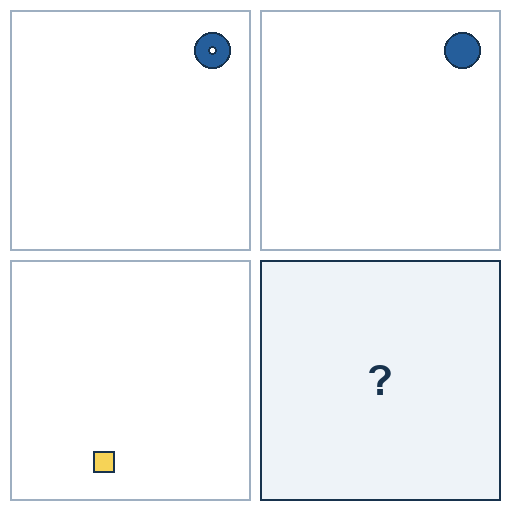
Answer C. Compare the completed left/right pairs. Remove existing center dots and add dots to unmarked shapes. Features not named by this rule stay unchanged. Compare all five choices, including partial changes.
- A: Repeats the starting arrangement instead of applying the complete rule.
- B: Changes the horizontal position of one object differently from the completed examples.
- C: Applies the complete demonstrated rule to every relevant object.
- D: Changes the vertical position of one object differently from the completed examples.
- E: Changes the color of one object differently from the completed examples.
Which piece completes the picture?
Look at the whole picture. Choose the piece that belongs in the empty space.
Show answer and explanation
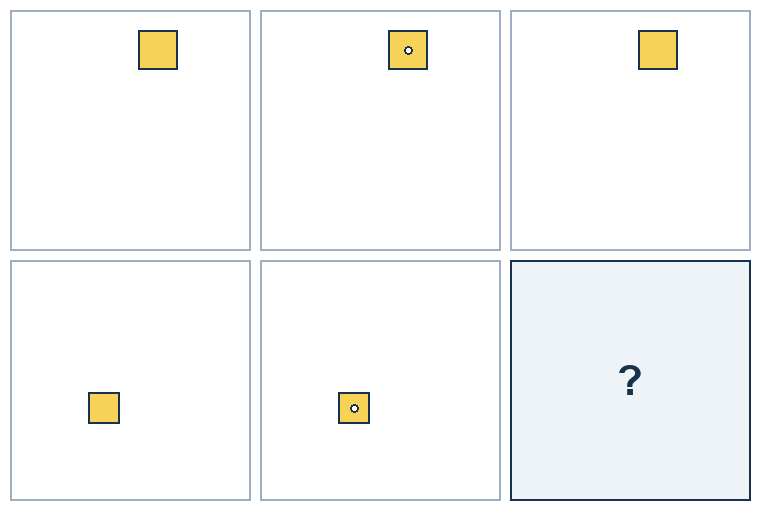
Answer D. Apply the same transition at each step in every row. Alternate the presence and absence of center dots. Features not named by this rule stay unchanged. Compare all five choices, including partial changes.
- A: Changes the horizontal position of one object differently from the completed examples.
- B: Repeats the starting arrangement instead of applying the complete rule.
- C: Changes the color of one object differently from the completed examples.
- D: Applies the complete demonstrated rule to every relevant object.
- E: Changes the vertical position of one object differently from the completed examples.
Which piece completes the picture?
Look at the whole picture. Choose the piece that belongs in the empty space.

Show answer and explanation
Answer E. Trace the surrounding pattern into the missing area. Continue the circular arcs so boundaries and color regions agree at all four edges. A choice matching only one edge is insufficient.
- A: The boundary positions are shifted. Trace every line and color region where it meets the gap.
- B: The boundary positions are shifted. Trace every line and color region where it meets the gap.
- C: The boundary positions are shifted. Trace every line and color region where it meets the gap.
- D: The boundary positions are shifted. Trace every line and color region where it meets the gap.
- E: All visible boundaries continue through the missing part.
Which piece completes the picture?
Look at the whole picture. Choose the piece that belongs in the empty space.
Show answer and explanation
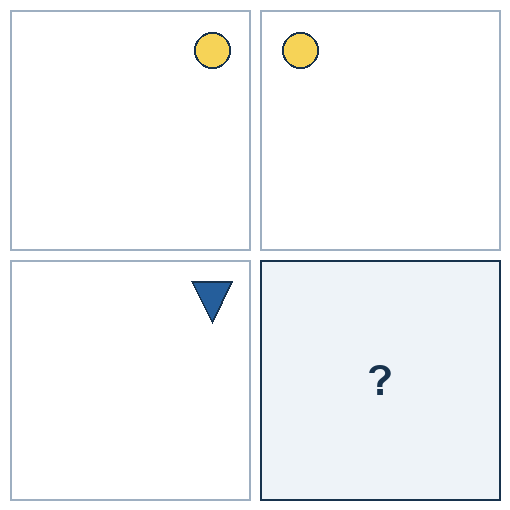
Answer E. Compare the completed left/right pairs. Reflect the arrangement left to right, including directional shapes. Features not named by this rule stay unchanged. Compare all five choices, including partial changes.
- A: Changes the vertical position of one object differently from the completed examples.
- B: Repeats the starting arrangement instead of applying the complete rule.
- C: Changes the color of one object differently from the completed examples.
- D: Changes the horizontal position of one object differently from the completed examples.
- E: Applies the complete demonstrated rule to every relevant object.
Which piece completes the picture?
Look at the whole picture. Choose the piece that belongs in the empty space.
Show answer and explanation
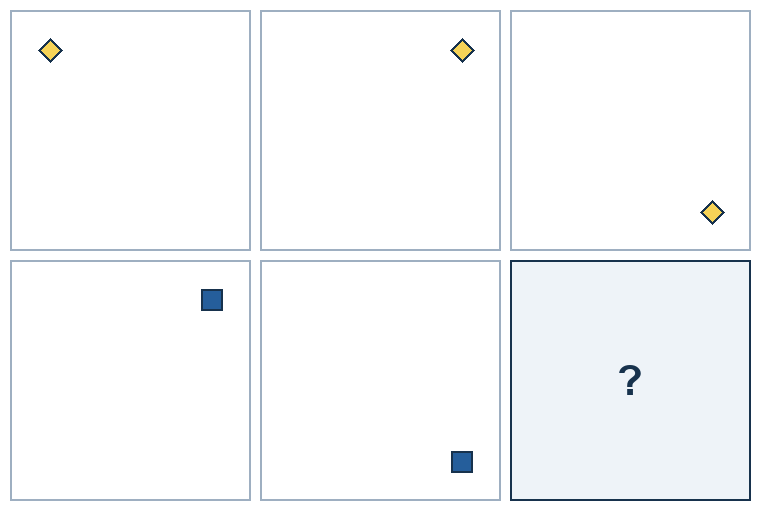
Answer E. Apply the same transition at each step in every row. Turn the whole arrangement one quarter turn clockwise. Features not named by this rule stay unchanged. Compare all five choices, including partial changes.
- A: Changes the color of one object differently from the completed examples.
- B: Changes the horizontal position of one object differently from the completed examples.
- C: Repeats the starting arrangement instead of applying the complete rule.
- D: Changes the vertical position of one object differently from the completed examples.
- E: Applies the complete demonstrated rule to every relevant object.
Which piece completes the picture?
Look at the whole picture. Choose the piece that belongs in the empty space.
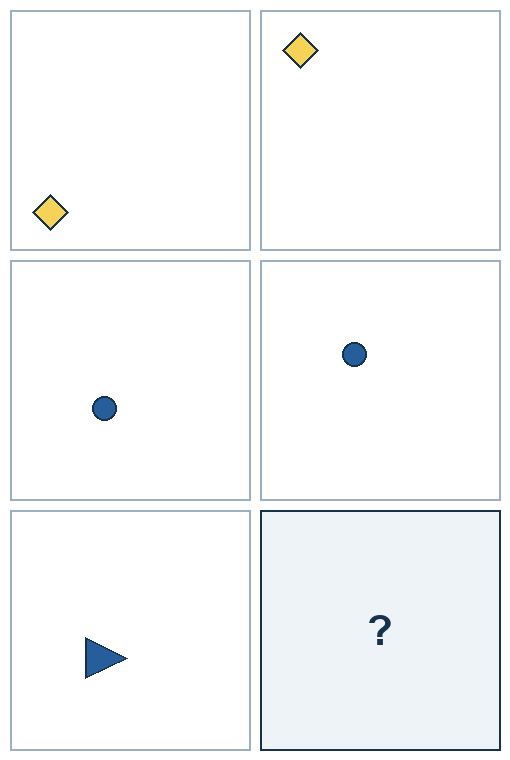
Show answer and explanation
Answer B. Compare the completed left/right pairs. Turn the whole arrangement one quarter turn clockwise. Features not named by this rule stay unchanged. Compare all five choices, including partial changes.
- A: Repeats the starting arrangement instead of applying the complete rule.
- B: Applies the complete demonstrated rule to every relevant object.
- C: Changes the vertical position of one object differently from the completed examples.
- D: Changes the horizontal position of one object differently from the completed examples.
- E: Changes the color of one object differently from the completed examples.
Which piece completes the picture?
Look at the whole picture. Choose the piece that belongs in the empty space.
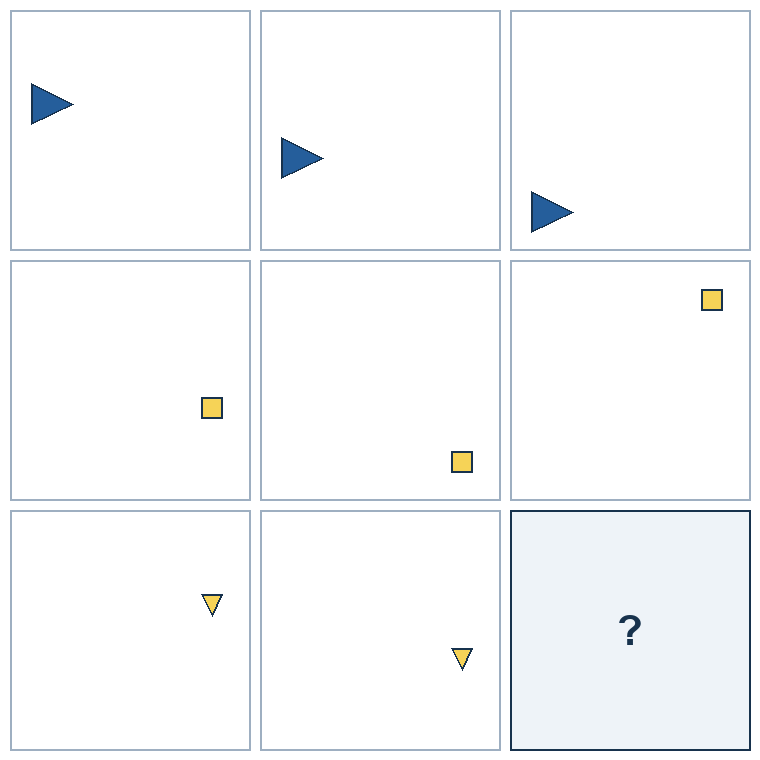
Show answer and explanation
Answer B. Apply the same transition at each step in every row. Move every object one grid position down; after the bottom edge it reappears at the top. Features not named by this rule stay unchanged. Compare all five choices, including partial changes.
- A: Changes the horizontal position of one object differently from the completed examples.
- B: Applies the complete demonstrated rule to every relevant object.
- C: Changes the vertical position of one object differently from the completed examples.
- D: Changes the color of one object differently from the completed examples.
- E: Repeats the starting arrangement instead of applying the complete rule.
Which piece completes the picture?
Look at the whole picture. Choose the piece that belongs in the empty space.

Show answer and explanation
Answer E. Trace the surrounding pattern into the missing area. Continue the staggered bars so boundaries and color regions agree at all four edges. A choice matching only one edge is insufficient.
- A: The boundary positions are shifted. Trace every line and color region where it meets the gap.
- B: The boundary positions are shifted. Trace every line and color region where it meets the gap.
- C: The boundary positions are shifted. Trace every line and color region where it meets the gap.
- D: The boundary positions are shifted. Trace every line and color region where it meets the gap.
- E: All visible boundaries continue through the missing part.
Which piece completes the picture?
Look at the whole picture. Choose the piece that belongs in the empty space.
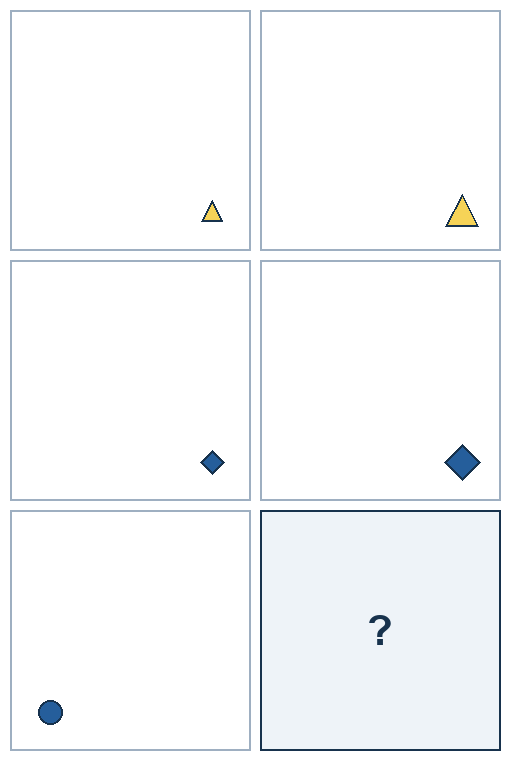
Show answer and explanation
Answer E. Compare the completed left/right pairs. Increase every object by one displayed size step; keep its center fixed. Features not named by this rule stay unchanged. Compare all five choices, including partial changes.
- A: Changes the vertical position of one object differently from the completed examples.
- B: Changes the color of one object differently from the completed examples.
- C: Changes the horizontal position of one object differently from the completed examples.
- D: Repeats the starting arrangement instead of applying the complete rule.
- E: Applies the complete demonstrated rule to every relevant object.
Which piece completes the picture?
Look at the whole picture. Choose the piece that belongs in the empty space.
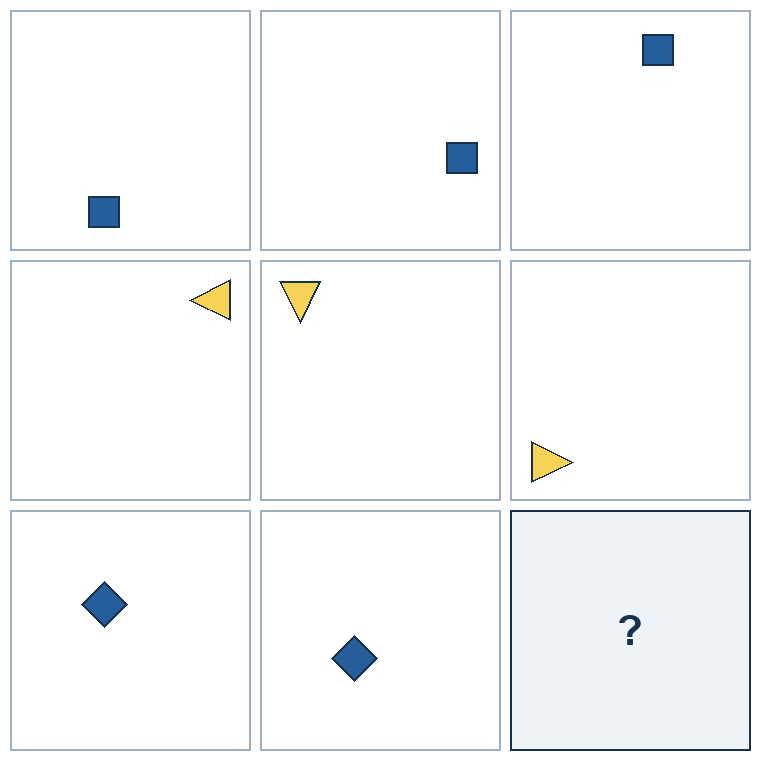
Show answer and explanation
Answer C. Apply the same transition at each step in every row. Turn the whole arrangement one quarter turn counterclockwise. Features not named by this rule stay unchanged. Compare all five choices, including partial changes.
- A: Repeats the starting arrangement instead of applying the complete rule.
- B: Changes the horizontal position of one object differently from the completed examples.
- C: Applies the complete demonstrated rule to every relevant object.
- D: Changes the color of one object differently from the completed examples.
- E: Changes the vertical position of one object differently from the completed examples.
Which piece completes the picture?
Look at the whole picture. Choose the piece that belongs in the empty space.

Show answer and explanation
Answer D. Trace the surrounding pattern into the missing area. Continue the stepped bands so boundaries and color regions agree at all four edges. A choice matching only one edge is insufficient.
- A: The boundary positions are shifted. Trace every line and color region where it meets the gap.
- B: The boundary positions are shifted. Trace every line and color region where it meets the gap.
- C: The boundary positions are shifted. Trace every line and color region where it meets the gap.
- D: All visible boundaries continue through the missing part.
- E: The boundary positions are shifted. Trace every line and color region where it meets the gap.
Which piece completes the picture?
Look at the whole picture. Choose the piece that belongs in the empty space.
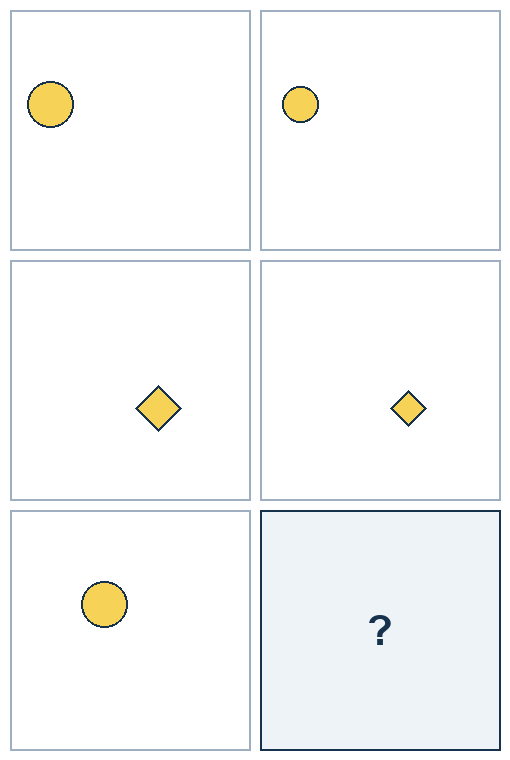
Show answer and explanation
Answer A. Compare the completed left/right pairs. Decrease every object by one displayed size step; keep its center fixed. Features not named by this rule stay unchanged. Compare all five choices, including partial changes.
- A: Applies the complete demonstrated rule to every relevant object.
- B: Changes the color of one object differently from the completed examples.
- C: Changes the horizontal position of one object differently from the completed examples.
- D: Repeats the starting arrangement instead of applying the complete rule.
- E: Changes the vertical position of one object differently from the completed examples.
Which piece completes the picture?
Look at the whole picture. Choose the piece that belongs in the empty space.
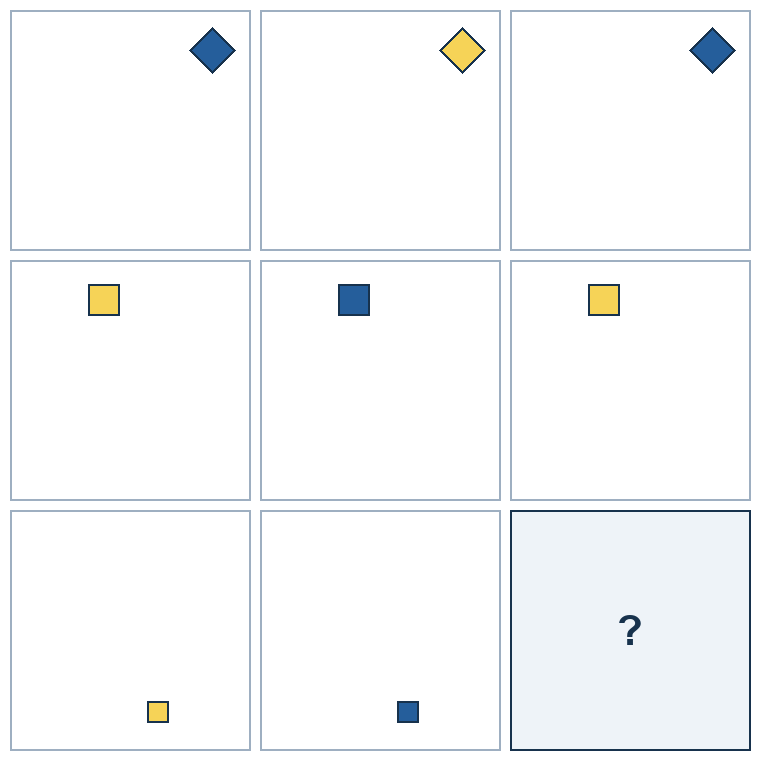
Show answer and explanation
Answer B. Apply the same transition at each step in every row. Alternate blue and yellow at each step. Features not named by this rule stay unchanged. Compare all five choices, including partial changes.
- A: Changes the vertical position of one object differently from the completed examples.
- B: Applies the complete demonstrated rule to every relevant object.
- C: Changes the size of one object differently from the completed examples.
- D: Changes the horizontal position of one object differently from the completed examples.
- E: Repeats the starting arrangement instead of applying the complete rule.
Which piece completes the picture?
Look at the whole picture. Choose the piece that belongs in the empty space.
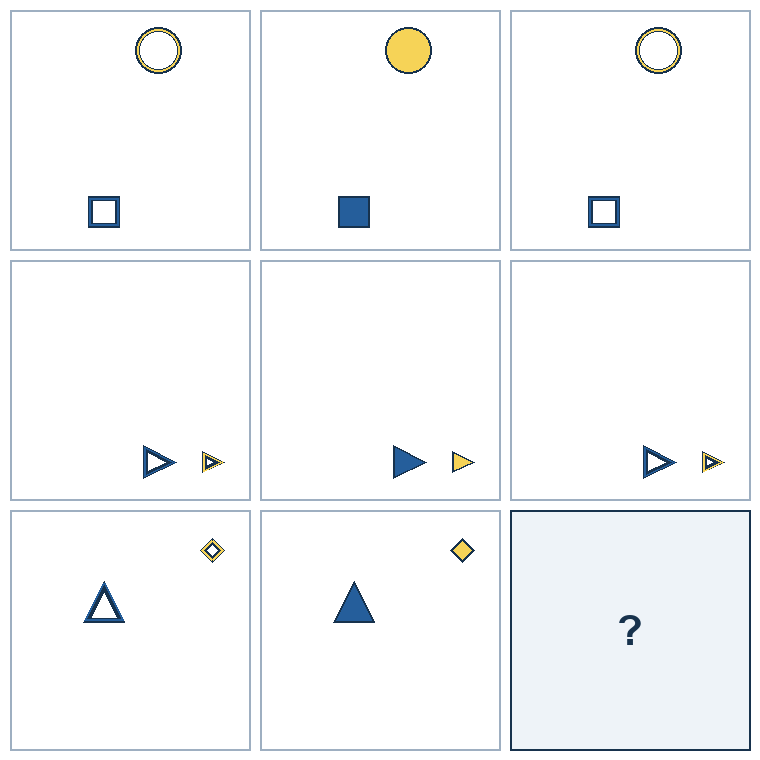
Show answer and explanation
Answer A. Apply the same transition at each step in every row. Alternate filled and outlined appearances. Features not named by this rule stay unchanged. Compare all five choices, including partial changes.
- A: Applies the complete demonstrated rule to every relevant object.
- B: Applies the rule to only some objects. Every relevant object must follow the same relationship.
- C: Repeats the starting arrangement instead of applying the complete rule.
- D: Changes the horizontal position of one object differently from the completed examples.
- E: Changes the vertical position of one object differently from the completed examples.
Which piece completes the picture?
Look at the whole picture. Choose the piece that belongs in the empty space.

Show answer and explanation
Answer D. Trace the surrounding pattern into the missing area. Continue the nested ellipses so boundaries and color regions agree at all four edges. A choice matching only one edge is insufficient.
- A: The boundary positions are shifted. Trace every line and color region where it meets the gap.
- B: The boundary positions are shifted. Trace every line and color region where it meets the gap.
- C: The boundary positions are shifted. Trace every line and color region where it meets the gap.
- D: All visible boundaries continue through the missing part.
- E: The boundary positions are shifted. Trace every line and color region where it meets the gap.
Which piece completes the picture?
Look at the whole picture. Choose the piece that belongs in the empty space.
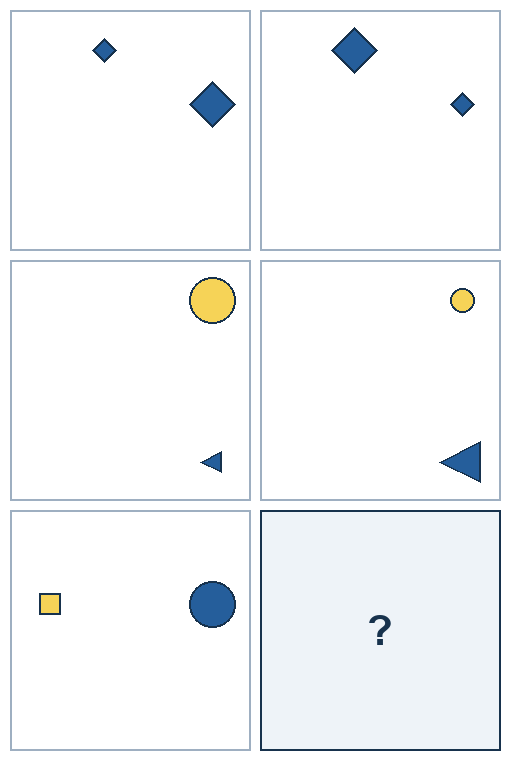
Show answer and explanation
Answer D. Compare the completed left/right pairs. Exchange the sizes of the first two objects while preserving other features. Features not named by this rule stay unchanged. Compare all five choices, including partial changes.
- A: Changes the vertical position of one object differently from the completed examples.
- B: Repeats the starting arrangement instead of applying the complete rule.
- C: Changes the horizontal position of one object differently from the completed examples.
- D: Applies the complete demonstrated rule to every relevant object.
- E: Applies the rule to only some objects. Every relevant object must follow the same relationship.
Which piece completes the picture?
Look at the whole picture. Choose the piece that belongs in the empty space.
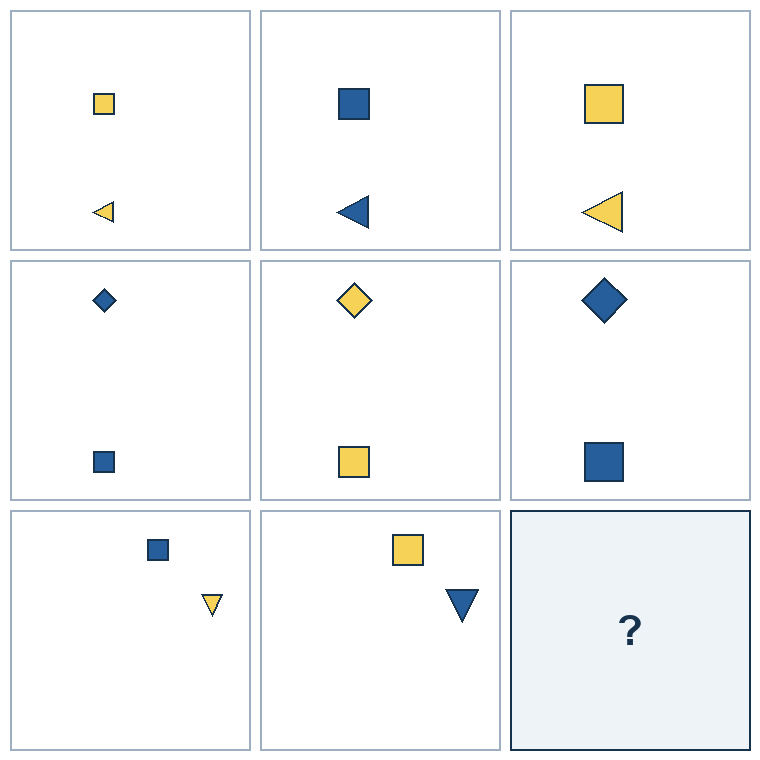
Show answer and explanation
Answer A. Apply the same transition at each step in every row. Increase each object one size step and alternate blue and yellow. Features not named by this rule stay unchanged. Compare all five choices, including partial changes.
- A: Applies the complete demonstrated rule to every relevant object.
- B: Changes the horizontal position of one object differently from the completed examples.
- C: Applies the rule to only some objects. Every relevant object must follow the same relationship.
- D: Repeats the starting arrangement instead of applying the complete rule.
- E: Changes the vertical position of one object differently from the completed examples.
Practice together, without pressure
Try four or five questions at a time. Ask what changed and what stayed the same.
Ask “Which clue helped you decide?” and “Why does another choice not fit?” The easy, medium and challenge labels are editorial estimates within this level.
Does this set give an official NNAT score?
No. These are original learning questions, not official assessment items. Practice answers do not provide an NAI, percentile or gifted-program qualification.
What should we do after these 18 questions?
Try the free interactive sampler for a short test-taking experience, or choose a matching Practice Pass for longer sessions, saved progress and full-length practice simulations.
Read the Grade 1 Level B guide → · Explore the visual guide →
When you are ready for more
Continue with timed Grade 1 practice
Try 48-question full-length practice simulations, shorter mixed and focused sessions, question-bank practice, and saved answer review. One-time $29 purchase for 90 days and one learner. No automatic renewal.
Level B is commonly associated with Grade 1; confirm the assigned level with your school.
Original independent practice reviewed by NNAT3.org’s Editorial Team. Not official NNAT questions or endorsed by Pearson. Confirm the edition and assigned level with your school.