A VISUAL REASONING LESSON
Reasoning by analogy
An analogy asks you to understand a relationship in a completed example and apply that relationship to a new picture. The answer must preserve the features that the rule leaves unchanged.
Updated October 8, 2026 · Independent parent guide
A step-by-step approach
- Compare the known pair. Inspect position, shape, color, size and direction separately. Identify what changes and what does not.
- State a rule you can test. “It looks different” is not enough. Try a precise description such as the inner and outer colors exchange places while the boundaries stay fixed.
- Apply it to every relevant part. If two objects are present, a choice that changes only one may be a tempting partial match. Check both before deciding.
Try an original worked example
Original worked example · five choices
Choose the piece that completes the picture. Attempt it before opening the explanation.
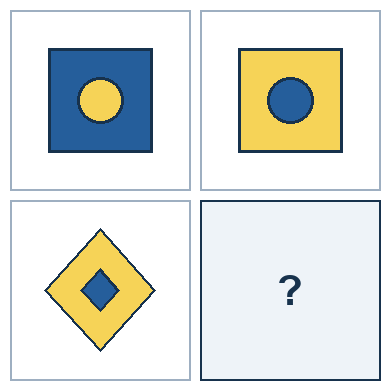





Reveal the answer and reasoning
Answer: C. The outer shape takes the inner shape’s color, and the inner shape takes the outer shape’s color. Their shapes, positions and sizes do not change. Apply the same relationship to the last left-hand picture and check every choice.
- A: Only one layer changes color; the demonstrated rule exchanges both layer colors.
- B: The horizontal position changes in a way the completed row does not show.
- C: The same relationship is applied to every relevant part, while the other features stay unchanged.
- D: This repeats the starting picture and misses the demonstrated change.
- E: Only one layer changes color; the demonstrated rule exchanges both layer colors.
Independent teaching example. Its level and difficulty are editorial estimates; it is not an official NNAT item or score predictor.
How to use this as a teaching activity
Begin with one clear relationship. After a successful explanation, use a fresh example with different shapes so the child must transfer the rule. Keep rotations and reflections distinct when discussing them.
Let the child attempt the problem before offering hints. If support is needed, ask a question about a clue instead of pointing to the answer. Discuss one tempting wrong choice after revealing the explanation.
Check the task, not just the category
This guide uses a teaching label to organize visual reasoning. It does not assert a separate official NNAT3 subtest score or a specific quota of these problems in each level. See the category overview and the level guide for scope.