A VISUAL REASONING LESSON
Pattern completion
A pattern-completion problem leaves part of a design empty. The task is to find a piece that preserves the surrounding pattern, not simply one with the same colors.
Updated October 8, 2026 · Independent parent guide
A step-by-step approach
- Start at the boundary. Trace a line or region where it enters the gap. Predict where it should leave. Check more than one edge before accepting a piece.
- Compare internal structure. A choice can meet an edge but contain a misplaced turn, region or crossing inside the tile. Check the shape of the whole missing part.
- Reject partial matches. A piece that matches the left edge but breaks the right edge is still wrong. Ask the child to name the mismatch rather than guessing again.
Try an original worked example
Original worked example · five choices
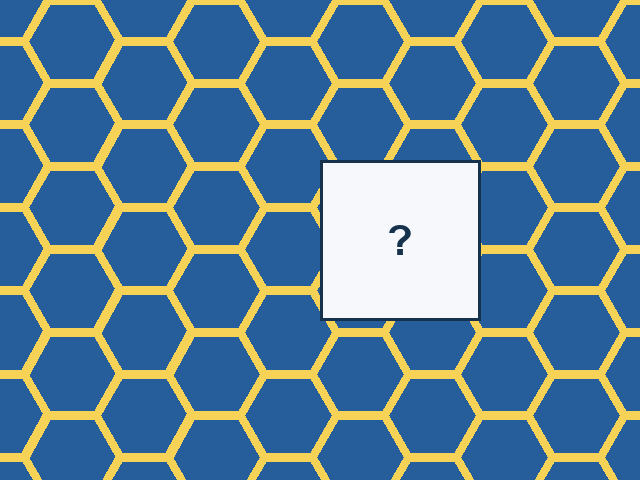
Choose the piece that completes the picture. Attempt it before opening the explanation.





Reveal the answer and reasoning
Answer: A. Continue the six-sided outlines. The sides must meet the neighboring hexagons without shifting the tiling. Compare all four sides; matching one edge alone is insufficient.
- A: Every visible boundary continues into the surrounding pattern.
- B: This shifts the pattern horizontally; compare every edge with the surrounding design.
- C: This shifts the pattern vertically; compare every edge with the surrounding design.
- D: This shifts the pattern in both directions; compare every edge with the surrounding design.
- E: This shifts the pattern in both directions; compare every edge with the surrounding design.
Independent teaching example. Its level and difficulty are editorial estimates; it is not an official NNAT item or score predictor.
How to use this as a teaching activity
Use a simple drawing with a missing square and discuss how its lines would continue. Move to denser patterns after the child understands the boundary check. Adding clutter is not, by itself, evidence of a higher reasoning level.
Let the child attempt the problem before offering hints. If support is needed, ask a question about a clue instead of pointing to the answer. Discuss one tempting wrong choice after revealing the explanation.
Check the task, not just the category
This guide uses a teaching label to organize visual reasoning. It does not assert a separate official NNAT3 subtest score or a specific quota of these problems in each level. See the category overview and the level guide for scope.